
Sep 23, 2026Applications
Structural Bolts for Bridge and Infrastructure Projects
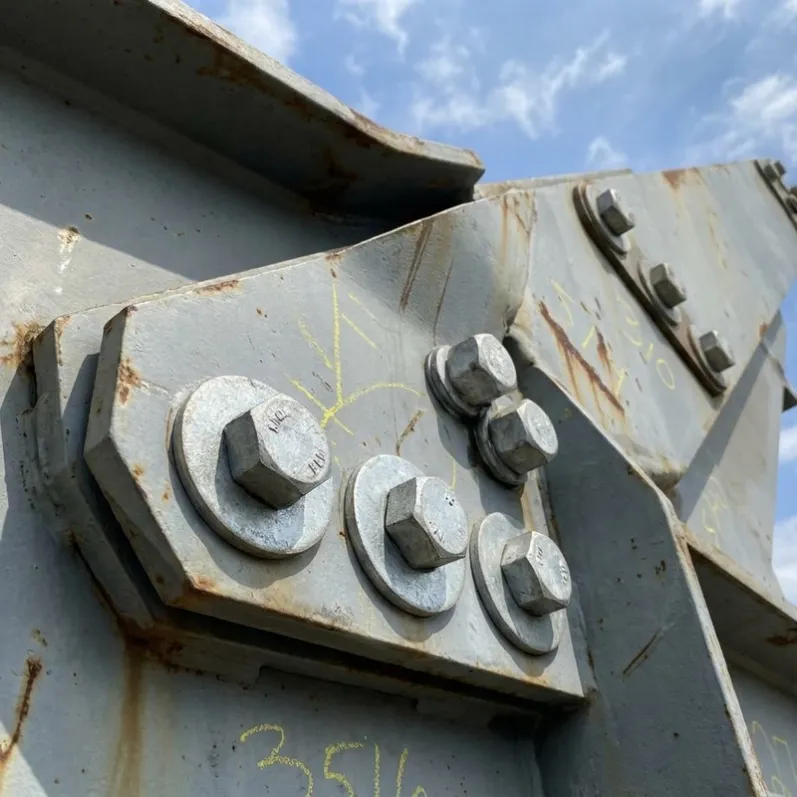
A modern steel bridge is held together by tens of thousands of structural bolts, most of them grade A325 or A490 hot dip galvanized, installed with calibrated tension-control tools. In a typical mid-span highway bridge, a single gusset plate connection can carry 30 bolts, each preloaded to 70% of its proof load. If one of them slips, corrodes, or fractures, the consequences are not theoretical.
This guide covers the role of structural bolts in bridges, transmission towers, and heavy civil infrastructure — what to specify, what to verify, and how to talk to a fastener supplier about A325 and A490.
ASTM A325 and ASTM A490 are the two most cited structural bolt standards in the United States.
- A325: Medium carbon steel, quenched and tempered. Type 1 (carbon-boron, carbon, or alloy), Type 3 (weathering steel). Minimum tensile strength 120 ksi (830 MPa) for diameters 1/2" to 1", and 105 ksi for 1-1/8" to 1-1/2".
- A490: Alloy steel, quenched and tempered. Higher tensile strength 150 ksi (1040 MPa) minimum. Used where higher preload or fatigue resistance is required.
Heavy hex bolt geometry:
- Head dimensions per ASME B18.2.6 (slightly larger than standard hex).
- Body diameter tolerance: ±0.015".
- Thread length: 2× diameter + 1/4" up to 6", longer sizes per spec.
- Marking: A325 → "A325"; A490 → "A490" plus manufacturer ID symbol.
Common finishes for outdoor structural use:
- Hot dip galvanized (HDG) per ASTM F2329 / A153: Most common. Zinc coating 50–85 µm. Excellent for outdoor, marine, and humid environments.
- Mechanical galvanized (ASTM B695): For tight-tolerance threads where HDG build-up is a concern.
- Plain / black: Indoor and shop-controlled environments only.
- PTFE / Xylan: Where galling is a concern in slip-critical connections.
Heavy hex structural bolts are used in:
- Highway and railway bridges: Main girder splices, gusset plate connections, deck-to-girder shear connections.
- Transmission and communications towers: Leg splices, cross arm to leg connections.
- Building structural steel: Column splices, moment connections, brace connections.
- Wind turbine towers: Internal flange connections (typically M36 to M48 at 10.9 / 12.9 metric).
- Railroad and crane structures: Special high-fatigue configurations.
In a slip-critical connection (Type SC), the faying surfaces are blasted and the bolts are tensioned to 70% of their minimum specified tensile strength. The friction between the plates — not the bolt shear — carries the load. This is why HDG roughness and surface preparation matter as much as the bolt itself.
A practical specification for a highway bridge contractor should specify:
- Standard and grade: A325 Type 1 HDG, or A490 Type 1 HDG.
- Diameter and length: in inches (e.g., 7/8" × 3").
- Thread: UNC (coarse) as default, UNF (fine) for vibration-sensitive joints.
- Finish: HDG per ASTM F2329, coating thickness 50–85 µm.
- Nut and washer matching: A563 heavy hex nut + F436 hardened washer, matched to A325 / A490.
- Marking: Each bolt head clearly marked "A325" or "A490", plus manufacturer ID.
For metric projects, the ISO 4014 / 4017 hex bolts in property classes 8.8 / 10.9 with HDG per ISO 10684 are the usual substitutes.
To source A325 / A490 structural bolts, send:
- Standard (ASTM A325 / A490 / ISO 4014-10.9-HDG)
- Diameter × length (e.g., 3/4" × 2-1/4", M20 × 100)
- Thread series (UNC / UNF / metric coarse)
- Grade (Type 1 / Type 3 / 8.8 / 10.9)
- Finish (HDG thickness 50–85 µm / mechanical galvanized)
- Quantity per size (typically 500–5,000 pieces per SKU)
- Nut and washer matching requirements
- Project timeline and destination port
Q: Can I mix A325 and A490 bolts in the same connection?
A: No. A325 and A490 have different preloads and different ductility assumptions. Mixing them leads to uneven load distribution. Always use one grade per connection.
Q: Do HDG bolts need to be re-tensioned after installation?
A: Not normally. But for slip-critical connections, HDG surface roughness can affect the slip coefficient (Class A vs Class B vs Class C per AISC). Verify the design slip coefficient before ordering.
Q: Are A325 / A490 bolts reusable?
A: A325: no, single-use only. A490: no, single-use only. Both are designed for the initial preload to develop yield at the bolt thread region. Once tensioned and released, the bolt is permanently elongated and should be discarded.
Send your project specification, bolt schedule (BOM), standard, diameter, length, grade, finish, quantity and destination port for a sourcing assessment and quotation. Our structural bolts program covers A325 / A490 heavy hex in HDG and mechanical galvanized, plus matched A563 nuts and F436 washers.